Tampilkan postingan dengan label sex crimes. Tampilkan semua postingan

Jumat, 18 Mei 2012

New sentencing hearing ordered based on junk sex-offender 'science'

Good news out of the Texas Supreme Court today, if not all one might hope from them. They ordered a new sentencing hearing for a man who's spent 13 years in prison on a 20 year sentence, granting resentencing not because he's innocent and the victim says the offense never happened (which happens to be the case), but because an expert at his trial based his opinions about future dangerousness on an instrument called the "Abel Assessment" whose ability to distinguish pedophiles from “nonoffenders was not significantly better than chance." Via the Austin Chronicle:
A unanimous Texas Supreme Court ruled today that Michael Arena, sent to prison for an alleged sexual assault that even the victim says never happened – is entitled to a new sentencing hearing.

Arena and his brother, John, were each accused as teens of sexually assaulting their young cousin, Stephanie Arena, when the girl was just seven-years-old. Stephanie soon recanted, however, and has been adamant that she was coerced into accusing her cousins at the behest of her mother, who was in a bitter divorce from her husband and had illegally removed Stephanie and her brother from Texas in violation of a court order. You can read the entire back story here.
According to the Austin Statesman:
The court ruled that Arena deserves a new sentencing trial because of false testimony by a psychologist, who during Arena’s 1999 trial labeled him a pedophile who was likely to strike again.

The psychologist, Fred Willoughby, based his conclusion on a test that required the then-16-year-old to click through images of swimsuit-clad people of various ages while the computer secretly measured how long he viewed each photo.

According to the unanimous opinion, written by Justice Eva Guzman, Willoughby testified that the test had an 85 percent accuracy rate. In reality, it was 65 percent.

Willoughby also misstated the scientific support for the test, saying independent studies had verified its effectiveness (none had) and quoting a Brigham Young University study as establishing its accuracy. Instead, the study raised serious questions about the test, noting that its ability to distinguish pedophiles from “nonoffenders was not significantly better than chance.”

Had he testified truthfully, Guzman wrote, “the trial court would have excluded Willoughby’s testimony.”
RELATED: 'Inmate challenges pedophilia test as junk science.'

Minggu, 22 April 2012

The half-empty glass: Reporting on juvie crime accentuates the negative

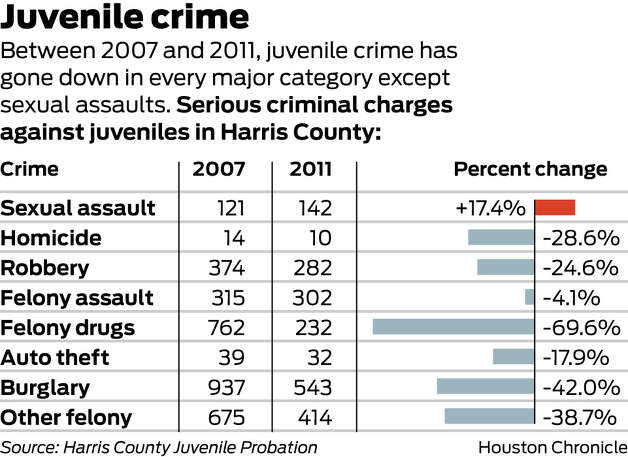
In a bit of a glass-half-empty story, the Houston Chronicle reported yesterday that sexual assaults are the only major juvenile crime category in Harris County which has not declined since 2007 ("Sex crimes by juvenile offenders are on the rise in Harris County," April 21):
In the last five years, the number of juveniles committing sexual assaults has increased 17 percent in Harris County while most other major juvenile crimes have shown significant declines, probation records show.
Sex offenses climbed from 121 to 142 during that period, while other violent juvenile crimes declined such as murder and robbery, dropping by 28 percent and 24 percent.
Here's a chart accompanying the story which graphically displays the data:


Writes reporter Cindy Horswell, "The U.S. Justice Department says 36 percent of sex crimes against children are committed by other children. Five percent of all sex offenders are younger than nine, and 16 percent are younger than 12, records show."

Certainly it's curious that sexual assaults alone continue to increase, with all other juvenile crime in Harris County seemingly in decline. But when the reporter jumps directly to the suggestion that we now have a new problem thanks to rising access to pornography, we've abandoned reasonable discussion for the kind of hype that sells papers but does little else. That we're dealing with very small numbers and countervailing overall trends encourages particular caution in over-interpreting the data. (That also goes for numerical declines in categories with small totals, including murder data.) In a jurisdiction the size of Harris County, a delta of 21 cases over five years is still small enough that any number of factors could affect it, from reporting rates by victims to charging decisions to changes in investigative focus by police.

Indeed, the same data could have been used to emphasize how far juvenile crime overall has fallen, a trend that's not limited to Houston. A recent report from the Juvenile Probation Commission (large pdf, p. 16) offered a statewide assessment that mostly jibes with Harris County's juvie crime drop: "In fiscal year 2011, there were 79,732 formal referrals to juvenile probation departments throughout the state. This represented an 11% decrease in referrals from the previous year (89,419 formal referrals in fiscal year 2010)." In 2001, according TJPC (see this report [pdf]), statewide juvenile referrals totaled more than 113,000, so we're talking about a significant drop in juvie crime over the last decade, even as the state's population ballooned.

The really good news, statewide even sexual offenses may be on the decline. The TJPC last year reported a slight drop in 2011 of juveniles in sex offender treatment programs, to 1,065 from 1,164 the year before. They also reported a drop in those receiving "residential placements" as sex offenders, from 368 to 310. While Grits can't immediately locate comparable data back to 2007, those numbers further recommend caution when interpreting Harris' situation. If expanded access to porn really caused an increase in Harris County sex assaults by juveniles, why hasn't it done so statewide?

Overall, juvenile crime trends in Texas are quite encouraging. But unfortunately good news on crime doesn't sell papers, hence the media focus on the single Harris County category with a worse outcome.

Grits continues to believe larger macro trends having little to do with the justice system account for much of the recent crime decline for both juveniles and adults. After all, even if you believe that keeping adults in prison longer (and for lessor offenses) has contributed to the overall, long-term crime reduction, that doesn't explain why juvie crime is declining even more rapidly. I often wonder if one of the biggest factors may be the rise of the internet, cell phones and video games, which occupy an extraordinary amount of youths' time that in my day would have been spent running the streets with much more potential for getting into trouble. The kid playing Grand Theft Auto IV for hours (or for that matter watching porn) is at home staring at a screen, not out jacking my car, spraying graffiti, burglarizing my house, etc.

Whatever the cause, with regards to juvie crime the glass is more than half full, scary headlines aside. It may sell newspapers, but hyping juvenile crime during this period of historic decline makes it harder to do more of what we are doing right and risks repeating old mistakes if the trend really does turn around.

Minggu, 01 April 2012

Lewisville sued over sex offender residency restrictions

The city of Lewisville has been sued over its residency requirements for sex offender registrants over and above state law, reports the Dallas News (behind paywall), with attorney Richard Gladden arguing that the ordinance prevents his client from living with his family. A reader pointed out this cogent reaction from a local who argues that "This ordinance was never really meant for public safety; it was meant for demagoguery. But its effects are punitive not only on the ex-offender, who ostensibly has done their time and paid their debt, but on their families. They are saddled with an additional burden at precisely the time when they need to be helping the ex-offender get back to being a productive, contributing member of society."

Kamis, 08 Maret 2012

TX Court of Criminal Appeals okays 'trial by polygraph'

The Texas Court of Criminal Appeals continues to struggle with how to handle junk science, issuing (at least) its second 5-4 opinion in the last year (Ex Parte Robbins is the other I have in mind) allowing courts to rely on known junk science, this time reversing the lower court to proactively affirm the use of polygraphs as a basis for revoking sex offenders' probation. Chuck Lindell at the Austin Statesman gives the only MSM account I've see of the case of William Leonard ("Appeals court allows polygraph evidence, in limited way," Mar. 8), whose probation was revoked because he failed 5 polygraphs during mandatory treatment. Other than the polygraph, "appellant was halfway through his treatment plan and had faithfully attended the required meetings, participated in group therapy, and fulfilled all other terms and conditions of the treatment program," according to Judge Cathy Cochran's dissent. Moreover, "his therapist testified that the polygraph results were the only reason Leonard was discharged from treatment." Lindell explains the import of the decision:
In a 5-4 decision Wednesday, the Court of Criminal Appeals upheld Leonard's probation and prison term, saying the polygraph results were admissible in court because the information formed the basis of the therapist's expert opinion.

"Even generally inadmissible facts or data may be used by an expert in forming an opinion, as long as the facts or data are of a type reasonably relied upon by other experts in the field," said Judge Lawrence Meyers, writing for the majority.

"Polygraph exams are reasonably relied upon by experts in sex offender psychotherapy," Meyers added.

The majority reaffirmed that polygraph results are always inadmissible before a jury.

But there is less danger of undue influence if the information is revealed during revocation hearings because there is no jury and because the judge "is not determining guilt of the original offense," Meyers wrote.

But Judge Cathy Cochran, writing in dissent, said the majority opinion employs logic that leads the legal system "down a very steep and slippery slope."

Leonard was sent to prison based solely on the failed polygraphs, Cochran wrote, despite numerous scientific studies and reports that have cast doubt on the accuracy of the tests.

"No court should admit or consider scientifically unreliable evidence," Cochran wrote, adding that Leonard experienced "not only ‘revocation by polygraph' but also ‘revocation by an expert's reliance on unreliable science.' "
The 11th Court of Appeals had reversed the trial judge's back-door theory for admitting inadmissible evidence, calling this "trial by polygraph," and that's exactly right. The Statesman headline says polygraph evidence will be allowed in a "limited" way, but Cochran's more accurate when she decries the "steep and slippery slope" down which the opinion launches the court's jurisprudence: The harm from allowing unreliable evidence as the sole basis for incarceration decisions isn't mitigated because the probation officer and/or the court deferred their evaluation to a therapist. Hokum is hokum, no matter who relies on it.

If it were one piece of evidence among a panoply resulting from an investigation, that's one thing (you'll sometimes see polygraphs used in actual innocence cases that way, particularly out of Dallas). However, as Cochran wrote, "Although an expert may base his opinion, at least in part, on otherwise inadmissible evidence, it must nonetheless be reliable inadmissible evidence." Or at least that was the case until yesterday. Now, probationers can be revoked based on testimony from experts who base their conclusions exclusively on unreliable evidence.

Bottom line, because we're talking about sex offenders, the courts are willing to bend over backward to maximize punitive sanctions, even to the point of allowing pseudoscience to dictate sentencing decisions, as in this case. But now that the precedent has been set, you can be sure prosecutors will get more creative about probation conditions that defer polygraph use to some third party so it will be admissible when it otherwise wouldn't be. Consider the implications, for example, of using polygraphs vis a vis treatment programs associated with DWI convictions: If that happened, this decision could balloon quite quickly into a big deal affecting a lot of cases.

See Judge Meyers opinion (joined by Keller, Hervey, Keasler and Alcala) and Judge Cochran's dissent (joined by Price, Womack and Johnson). I'm particularly disappointed to see Judge Alcala was the critical swing vote for Keller and Co. on the opinion. There are a ton of junk science issues looming before criminal courts in the wake of the National Academy of Sciences reevaluation of forensics, so this blasé attitude toward relying on junk science bodes particularly ill at this historical juncture.

Bad, bad opinion. So bad maybe the Lege should act next year to say that polygraph tests can't be the sole basis for probation revocation, whether they're administered by law enforcement or a therapist at the direction of the court.

Selasa, 06 Maret 2012

Christmas in March for Amarillo man freed due to flawed forensics in child death

In a story earlier featured on PBS Frontline, NPR, and ProPublica, which brings the latest news, Ernie Lopez returned home to Amarillo yesterday after the Texas Court of Criminal Appeals invalidated his conviction because his defense attorney did not call expert witnesses to invalidate the science underlying his conviction for child sexual assault. The CCA "didn't absolve Lopez, but said there was a 'reasonable probability' that he would have been acquitted had his attorneys countered the medical evidence arrayed against him." Says ProPubica:
Lopez's story reflects a broader controversy. Increasing numbers of doctors and other experts are questioning the reliability of the science used to prosecute cases of fatal child abuse and sexual assault. In Canada and the U.S. at least 23 people who were wrongly accused of killing children based on flawed or biased work by forensic pathologists have been cleared over the last 15 years.

The Texas court's ruling set the stage for Lopez to be released Friday on a $10,000 bond. His release order bars him from initiating contact with children, though he is allowed to spend time with his three children. It also requires him to wear an electronic monitoring anklet and to abide by a 10 p.m. to 6 a.m. curfew.

At his parents' home on the outskirts of Amarillo, Lopez celebrated the events and holidays he missed during his long confinement. The family even put up a Christmas tree.
Related: TX conviction overturned because of failure to challenge junk science in child death case.

Jumat, 02 Maret 2012

'Inmate challenges pedophilia test as junk science'

The Austin Statesman's Chuck Lindell reports ("Inmate challenges pedophilia test as junk science," March 2) on a legal challenge by TDCJ inmate Michael Arena - who was convicted of sexually assaulting two young cousins when he was a teenager - to use of a particularly insidious brand of junk science aimed at sex offenders called the Abel Assessment, which is based on similar principles to the penile plethysmograph. (Try saying that three times fast.) Neither forensic technique is allowed to be used at trial under modern evidence standards - and probably shouldn't have been in this case - but the plethysmograph is still used rather frequently in post-conviction settings in Texas, particularly among parolees who're assigned sex-offender conditions. The Abel Assessment suffers from an error rate of 35-48%, according to various estimates in Lindell's article. One study found "a 42 percent false-positive rate when non-molesters were tested."

In Arena's case, his claims about the test's inaccuracy are bolstered by the recantation of both alleged victims, who say they were encouraged to lie by their mother who was going through a bitter divorce. Writes Lindell:
Though interest in Arena's case tends to focus on his claim of innocence, his attack on the psychological test could influence future attempts to challenge allegedly bad science in the courtroom — a continuing problem that the nation's appellate courts have struggled with for decades.

The test, defense lawyers say, had an unacceptably high 35 percent error rate that was not disclosed to Arena's judge and jury. It was never intended to be used to identify pedophiles, they claim, and a university study found that its results were little better "than chance" when trying to distinguish pedophiles from non-pedophiles.

In addition, the psychologist who examined Arena inflated the test's effectiveness and scientific support when he testified at Arena's trial, leading to a reprimand from a state regulatory agency four years later, court records show.

Issues with the test seemed to resonate with many of the Supreme Court's nine justices during oral arguments in January.

Justice Nathan Hecht dismissed the test as "bordering on hokum" and less likely to yield valid results than lie-detector tests, which are not admissible in criminal court proceedings.

Justice David Medina noted that a 65 percent accuracy rate would have earned the test an F in a school setting. "To incarcerate somebody for one day, you use a standard that's not even A-plus?" Medina asked lawyers for Bell County. "That seems wrong on its face."

Lawyer John Gauntt Jr. with the Bell County attorney's office acknowledged that a 35 percent error rate was "not a suitable standard" for use in court. He also acknowledged that the prosecution's expert, Georgetown psychologist Fred Willoughby, provided false testimony about the test's effectiveness in the Arena case.

Even so, Gauntt told the court, the 20-year sentence should not be overturned because Arena cannot prove he was harmed by Willoughby's testimony — a necessary step toward earning a new sentencing trial.
Lindell includes an interview with Michael Arena, speaking from a Texas prison:


Notably, this case is being heard by the Texas Supreme Court instead of the Court of Criminal Appeals because Arena was convicted as a juvenile. That's important because civil courts generally have much more rigorous standards for scientific evidence, in part because both sides in civil litigation have money to routinely hire experts. By contrast, in most criminal cases the prosecution has most if not all of the access to lab resources and forensic expertise unless the defendant pays for it or a judge orders it. These are judges who're used to seeing science in the courtroom held to much higher standards than their counterparts on the Court of Criminal Appeals, and Lindell's account of oral arguments in Arena's case shows the Abel Assessment is getting a more skeptical reception from the Texas Supreme Court than junk science sometimes receives from Judge Keller and Co. on the other side of the building.

Selasa, 15 November 2011

John Bradley's Willie Horton?

The blog Wilco Watchdog goes for the jugular vs. District Attorney John Bradley and District Judge Ken Anderson, attacking their "tuff on crime" credentials head on by exploring a plea deal they cut with an alleged child molester - from a 3rd degree felony to a Class A misdemeanor -  who later showed up on NBC Dateline's "To Catch a Predator" series:
Thanks to the reduced charges, the defendant spent 97 days in jail for the misdemeaor then went on his merry way until Dateline caught up to him. Wrote the Watchdog, "It is one thing to just be sloppy or have temporary lapses in judgment, but it is quite another thing to turn a child predator loose with a slap on the wrist, freeing him to act again." That's a rough and tumble attack, but it's also the kind of thing John Bradley slings at others all the time in the press without giving it a second thought: Live by "gotcha" politics and you may well die by it.

In a past life, Grits was a professional opposition researcher for around 13-14 years, working in a total of roughly 68 campaigns, and I can't recall a candidate with as much negative research handed to the opposition on a platter before you even get started digging. Offhand:

1. Delaying the Todd Willingham investigation at the Forensic Science Commission, leading to a refusal by the Republican-controlled Texas Senate to confirm his nomination (lots of negative quotes about his performance just a Google search away).
2. The Michael Morton fiasco: Opposing DNA testing and disclosure of exculpatory evidence withheld from the defense. Dismissive comments about Morton to the press while he was in prison.
3. Cynical attitude toward innocence and DNA testing.
4. Tried to water down Texas' much-praised probation reforms.
5. Behaves like a bully.
6. The UnCatch a Predator angle, which includes footage that would make a devastating TV commercial.

These are messages that, combined with a general anti-incumbent sentiment among voters, create plenty of fodder for attacks against John Bradley in the electoral arena. And those are just the easy ones. A full-blown opposition research effort would inevitably discover more given how long he's been in office. You'd want to poll them to see which ones resonated most with the public, but any one could be devastating. Collectively they could wipe the incumbent off the electoral map if he faces opposition with enough money to deliver those messages to the voters. Bradley already has drawn a Democratic opponent in 2012, but anyone with a D by their name is at best a longshot in Williamson County. However, rumors are swirling that Bradley may face an opponent in the GOP primary, which would be an even greater threat.

UPDATE: For another, similar tale from the Wilco Watchdog, see also "To Uncatch a Predator: Another predator, another catch and release." In that sordid tale, a local law enforcement official was allegedly given a relatively light sentence when accused of fondling his underage step daughter.

Minggu, 30 Oktober 2011

Texas media waits till last minute for annual Halloween sex offender hype

Grits had been somewhat surprised this year that fewer Texas media outlets had succumbed to the annual Halloween hype over monitoring registered sex offenders out of fear they may give out candy. But on the weekend before Halloween, such stories appeared with a vengeance, especially on local TV news, see here, here, here, here, here, and here.

In politics, Halloween is when demagogues take their latest fear mongering tactics out for a spin to see if a gullible public will bite, and how hard. As the National Post put it, “A one-night festival of ghoulish subject matter, unhealthy food and talking to strangers, it is no surprise that Halloween is an annual magnet for moral criticism. Halloween is when parental paranoia is 'market-tested,' American columnist Lenore Skenazy wrote in a 2010 blog post. 'If a new fear flies on Halloween, it’s probably going to catch on the rest of the year, too.'”

Which is how we get this annual flurry of sex-offender-related stories on Halloween. Forget for a moment that there are only two instances that anyone has identified in the history of the nation of kids being sexually assaulted on Halloween, and in neither instance did the offender have a criminal record that would place them on the sex-offender registry. Reality isn't as important as the opportunity for hyping fear.

When Grits first noticed this annual phenomenon several years ago I blamed the media. But tracking it closely, one discovers that nearly all local stories on the subject stem from a press release from the local Sheriff, probation department, or some other official, local source, so really it's law enforcement hyping the issue that drives coverage. Since it's not actually news but really just self-interested spin, I doubt the media would bother to produce these stories on their own without explicit prodding from officialdom.

Bottom line: Your kids are in FAR greater risk from traffic accidents, drunk drivers, or even being struck by lightning (not to mention obesity and tooth decay) on Halloween than from sex offenders luring them with sweets. Indeed, in terms of sex crimes against children, Halloween may actually be the safest day of the year. If you're lecturing your kids on the risks from sex offenders before they go out instead of making sure they can safely see through their Halloween mask and reminding them to watch for traffic, you're probably diverting their attention - and yours - from the most serious public safety issues surrounding the holiday.

MORE: James Alan Fox makes the excellent point that there is indeed a crime spike on Halloween, but that it's not sex offenses against children but workaday street crime that routinely increases on that day and should be the main policing focus.

AND MORE: See related items from Diane Dimond , Karen Franklin, and at Slate.

See related Grits posts:

Minggu, 25 September 2011

Parole board continues shell game over due process for sex-offender conditions

A federal judge on Tuesday issued yet another bench slapping to the Texas Board of Pardons and Paroles over the BPP's insistence on placing sex-offender conditions on (possibly) thousands of parolees who've never been convicted of a sex crime. Reported Mike Ward at the Austin Statesman:
The latest decision came Tuesday when U.S. District Judge Lee Yeakel of Austin approved an injunction blocking state parole officials from enforcing sex-offender restrictions on a Fort Worth parolee who said he has been threatened with being sent back to prison if he doesn't waive his right to a hearing.

Last week, the Texas Court of Criminal Appeals ordered the restrictions — officially called Condition X — removed from the parole conditions for a Houston kidnapper because he was not afforded a due-process hearing before they were imposed and because he had not been convicted of a sex crime.

The decisions were the latest setback for the Texas Board of Pardons and Paroles and state corrections officials, who have insisted for years that, to ensure public safety, they could impose the stringent conditions on parolees without a due-process hearing .

Although previous court rulings have required the hearings, the state has not routinely offered them. And parole attorneys say the two recent cases indicate the courts are losing patience.
To clarify Ward's assessment, the hearing before Yeakel wasn't exactly about the parolee "waiving" a hearing. Instead, parolee Buddy Yeary sought to be released from Conditions "X" because he was never afforded due process. In response, the parole board ordered Yeary to undergo a sex-offender evaluation including a plethysmograph test - which is a bit of unproven junk science that courts have excluded at trial for its lack of reliability but which is routinely used in post-conviction evaluation and monitoring of (in this case alleged) sex offenders.  Yeary was told was told that if he did not complete the evaluation and plethysmograph by 5 PM on Tuesday, September 6th, that his parole would be revoked. Judge Yeakel wouldn't allow it, though, issuing a temporary restraining order and ultimately removing Yeary's sex-offender conditions.

Via email, I asked one of the attorneys in the case, Bill Habern, what this meant for other, similarly situated parolees, and he responded thusly: "We do not know what impact will attach to this decision as it applies to other non-plaintiff's in the same class. I have yet to see the written order from the court. When it is filed I will forward you a copy. The judge was quite 'expressive' in his comments and concerns over why this issue continues to live on when the parole agencies have long faced the consistent decisions from Coleman, Meza, Graham, Evans, Baker, and the case last week from the CCA. Yeakel suggested the parole agencies apply a little 'common sense' to what these decisions mean in relationship to the other parolees."

Another oddity, says Habern: An "astounding thing that we learned [at the hearing] was that the number of people who had no hearings but were on Coleman supervision dropped from the Board's last number of approximately 7,000 down to about 140. No one knows what seems to have happened to the other 6,860 that Troy Fox testified to during the Graham case. It all makes no sense to either Richard [Gladden] or I." Who knows what the real number is, since both have been sworn to in court and no explanation was provided for the difference.

The drama doesn't end there, however. In response to this increasingly long list of judicial bench slappings, the parole board recently created a new policy (pdf) - which has not yet been reported in the MSM - aiming to apply "Condition X" prior to release on parole instead of after release. Wrote Habern, the parole board is:
sending notice to such offenders informing them they have been approved by the parole board for parole subject to their agreeing to enter sex offender treatment while in TDCJ and thus waiving their Coleman rights to due process. If they do not agree,. then their parole approval will be re-considered by the Board. ... We are hearing that the offenders are being coerced into signing these waivers in order that at least they get out of prison even if on sex offender parole, and even though they end up on sex offender supervision and are denied all due process from the point of signing the attached documents forward.
The parole board now asks inmates so situated - prior to being granted parole - to waive the due process rights Yeakel and Judge Sam Sparks have said should be afforded before Condition X is applied, including access to counsel, and a hearing, with the right to examine and cross examine witnesses.  Habern notes that "With the backup in the prison sex program of up to 10 months plus, and in some cases with an 18 month program, it means you may have a document that says you are to be paroled - maybe -  in 28 months in some cases."

Habern adds that the new waiver form violates inmates' 5th Amendment rights against self incrimination, telling potential parolees "that if they admit to other crimes for which they have not been charged,  those admissions will be passed on to prosecutors (the inmates have no lawyers at the time of these evaluations), and instead of a hearing, as required by Coleman, Meza and Evans, they will be given 30 days to respond in writing as to why they should not be placed in sex offender supervision. This skips right over many of the elements of due process the law requires," said the veteran parole attorney.

So the Board of Pardons and Parole is essentially playing a shell game, attempting to hide the pea (a due process hearing required under the Coleman case) amidst an ever-dizzying array of changing policies and procedures.

Habern points to court precedents relying on the Coleman decision from other parts of the country that indicate due process should be required before labeling prisoners a sex offender whether or not they've been released yet on parole. In Pennsylvania last year, the US 3rd Circuit Court of Appeals ruled in Renchenski v. Williams (pdf) - based explicitly on the 5th Circuit analysis in Coleman - that “prisoners who have not been convicted of a sex offense have a liberty interest created by the Due Process Clause in freedom from sex offender classification and conditions,” whether they are in prison or have already been paroled. (The plaintiff Renchenski in that case is serving a sentence of life without parole.)

Though Renchenski carries no precedential value in Texas, the 3rd Circuit case was appealed to the US Supreme Court, which denied cert. So SCOTUS saw nothing wrong with the 3rd court's interpretation of  5th Circuit's pronouncements on liberty interests related to sex-offender conditions. It would be surprising if the federal judges  who've been slapping around the Texas parole board choose to ignore that interpretation and allow this new procedure to stand.

All this posturing and hair splitting by the parole board serves just one purpose: To avoid admitting a mistake and complying with repeated findings in state and federal court that due process is required before assigning parolees sex-offender conditions when they haven't been convicted of a sex offense.

The solution is as simple as it is unlikely to be implemented by the parole board without an explicit court order: The parole board should hold hearings before assigning sex-offender conditions to parolees and remove those conditions in cases where hearings weren't held. The longer they wait to do this, the more likely they are to be held liable in pending civil rights litigation over the subject. At this point the board seems to be willfully thumbing its nose at federal courts, and as a general rule that approach doesn't end well.

See related Grits posts: